
A favorable carbon comparison does not establish the local releases from a pyrolysis installation. Organize the evidence by source, operating state and measurement method before drawing a conclusion.
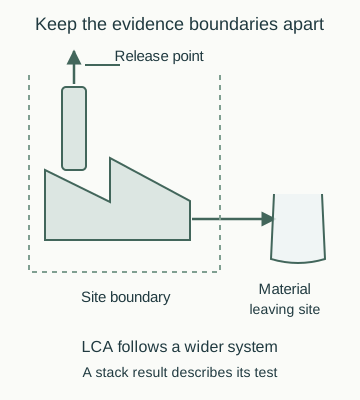
Ask separately about measured releases at the installation, material sent to other facilities and life-cycle greenhouse-gas accounting. Each needs a defined boundary and its own evidence. The checklist below helps expose missing information; it supplies no emissions limit, permit determination or health-risk verdict.
Define the installation you are reviewing
Obtain a current process description and site boundary. Identify which preparation, conversion, gas use, product handling and residue operations are included. Record whether off-site treatment or later upgrading falls outside the installation evidence you have received.
The process-flow guide shows why several material routes exist. An emissions review should follow those actual routes, rather than treating the reactor as the whole facility. Ask the operator to identify release points and control arrangements; this article’s schematic is not an as-built emissions inventory.
Build an evidence matrix by source
| Evidence group | Request | What it can establish |
|---|---|---|
| Defined release point | Source ID, process served and control equipment | Where a reported measurement belongs |
| Test report | Method, sampling location, dates, units and results | What was measured under the reported conditions |
| Operating context | Feed description, throughput and operating state during test | Whether the result describes the state being assessed |
| Non-routine operation | Startup, shutdown, upset and handling records as applicable | Conditions outside the ordinary test window |
| Product and residue streams | Characterization, quantity and destination | Material leaving by a route other than the measured outlet |
| Control-system records | Relevant operating parameters and maintenance history | Whether the test’s control conditions persisted |
The US EPA Emission Measurement Center provides stationary-source test-method information and technical assistance. It is a starting point for identifying methods, not a finding that any particular method or limit applies to your facility. The responsible authority and qualified technical team must establish the applicable current requirements.
Read a result with its method and basis
Keep pollutant identity, units, averaging period, gas-volume reference conditions and any stated correction together. A concentration, mass rate and annual inventory are different quantities. Do not compare them directly or convert between them without the required flow and operating information.
Record detection or quantification limits and the laboratory’s reporting convention. A non-detect is bounded by the method and sample; it is not proof that the substance cannot be released. Keep uncertainty and qualifications from the report visible when summarizing it.
Check whether the test describes representative operation. A result from one feed and operating state does not automatically describe a different feed mix, startup or upset. Identify the missing condition as a question requiring evidence, without assuming a favorable or adverse answer.
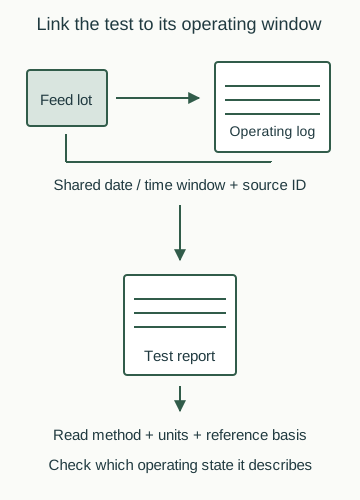
Match the feed-lot record and operating log to the test window and source ID. Preserve any sample identifiers in the report so a later reviewer can trace its basis. Use the feedstock checks to identify missing material records.
Keep life-cycle comparisons in a separate table
Plastic Energy’s January 2025 LCA executive summary, pages 3–4 and 8, distinguishes waste and product perspectives, describes a European system and states exclusions. Those choices affect what its comparison means. It is a process-specific life-cycle study, not a stack-test report for another installation.
For any carbon claim, record the functional unit, geography, reference year, electricity and heat assumptions, allocation or credit method, displaced treatment and downstream steps. Confirm that two studies perform comparable functions before presenting their results side by side.
Record the gaps without converting them into a verdict
Use an open-questions register: missing document, affected source or claim, reason it matters, responsible party and evidence needed to close it. Examples include a test without its operating log or a carbon percentage without the underlying comparison boundary.
A missing record prevents a supported conclusion on that point. It does not by itself prove compliance, noncompliance or a health outcome. Preserve that distinction when writing a public summary or requesting more information.
Methods and scope
This is an editorial evidence-organizing method based on an official measurement resource and a documented LCA boundary. It does not interpret a facility permit or assess individual exposure. Continue in packaging waste recycling for the related process questions. Updated October 2026.