
Calling pyrolysis oil “recycled plastic” can hide the processing that still lies between them. Follow the prepared feed through conversion, separation and downstream treatment before describing a complete recycling chain.
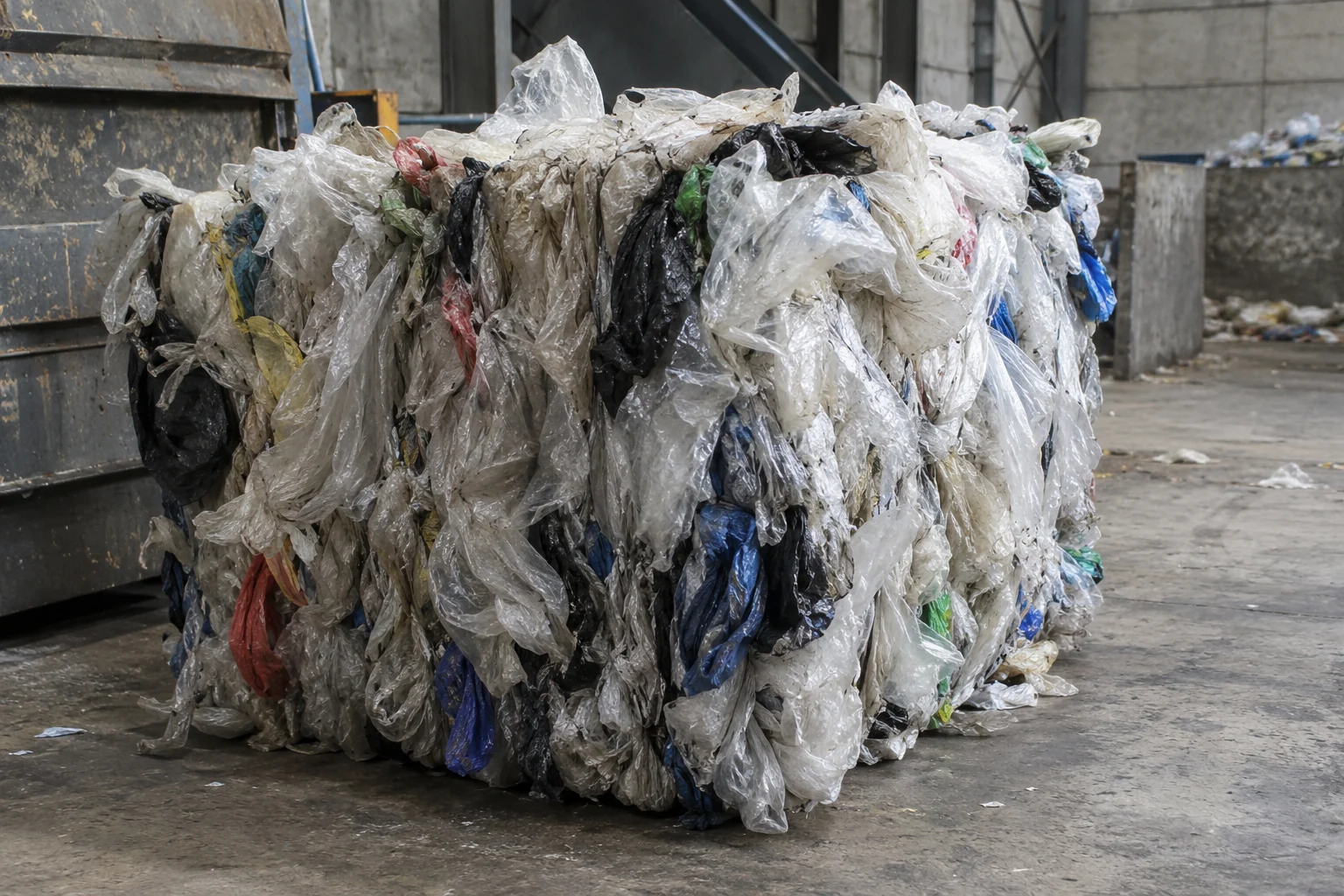
Plastic pyrolysis thermally converts prepared plastic feedstock into streams that require characterization and a destination. In the public process example used here, the liquid intermediate needs further treatment before chemical manufacture. New plastic granules require additional production stages; they are not the direct output of the pyrolysis reactor.
Start with prepared feed, not an unspecified waste pile
Enerquip’s process explanation describes heating plastic in the absence of oxygen. This distinguishes the conversion step from subsequent combustion of a recovered gas or fuel.
Record the incoming packaging stream and the plant’s acceptance basis. Sorting and other preparation determine which material reaches conversion and which material leaves as a rejected fraction. Record that rejected stream rather than making it disappear from the process description.
Plastic Energy’s January 2025 LCA executive summary, pages 5–7, shows sorting and extra sorting before its pyrolysis step. It is one provider’s documented system, not a universal plant design. The feedstock preparation guide turns that receiving boundary into practical questions.
Keep the conversion outputs separate
A process description needs the condensable stream, non-condensable gases and solid residue, together with their actual destinations. Do not assume that every gas is sold or that every solid is a useful product.
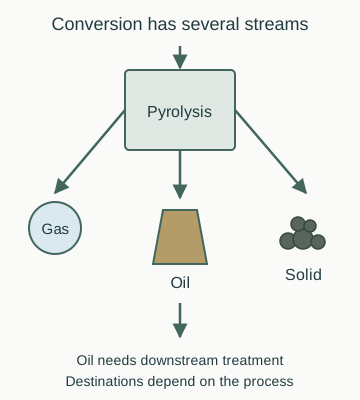
In Plastic Energy’s study scenario, the process produces TACOIL, process gas used to heat the reactors and char sent to landfill. The oil undergoes hydrotreatment before use as chemical-industry feedstock. Those destinations belong to that scenario. Another installation needs its own stream analysis and documented handling routes.
The Japan Petroleum Institute review overview, published in 2016, describes oil and gas production and the difficulties introduced by some polymers. Its accessible abstract supports this broad distinction. It does not establish a yield, temperature or run time for your proposed feed.
Trace oil through the later manufacturing stages
In the LCA’s product perspective, downstream steam cracking and polymerisation extend the chain to LDPE granulate. A reactor outlet or a truckload of oil therefore represents an intermediate boundary in that system.
Ask what quality specification applies at each transfer and whether treatment or blending occurs before the next stage. Keep the physical material route distinct from any accounting or attribution scheme. A claim about recycled content requires its own applicable evidence; the flow diagram alone cannot establish the content of a particular finished package.
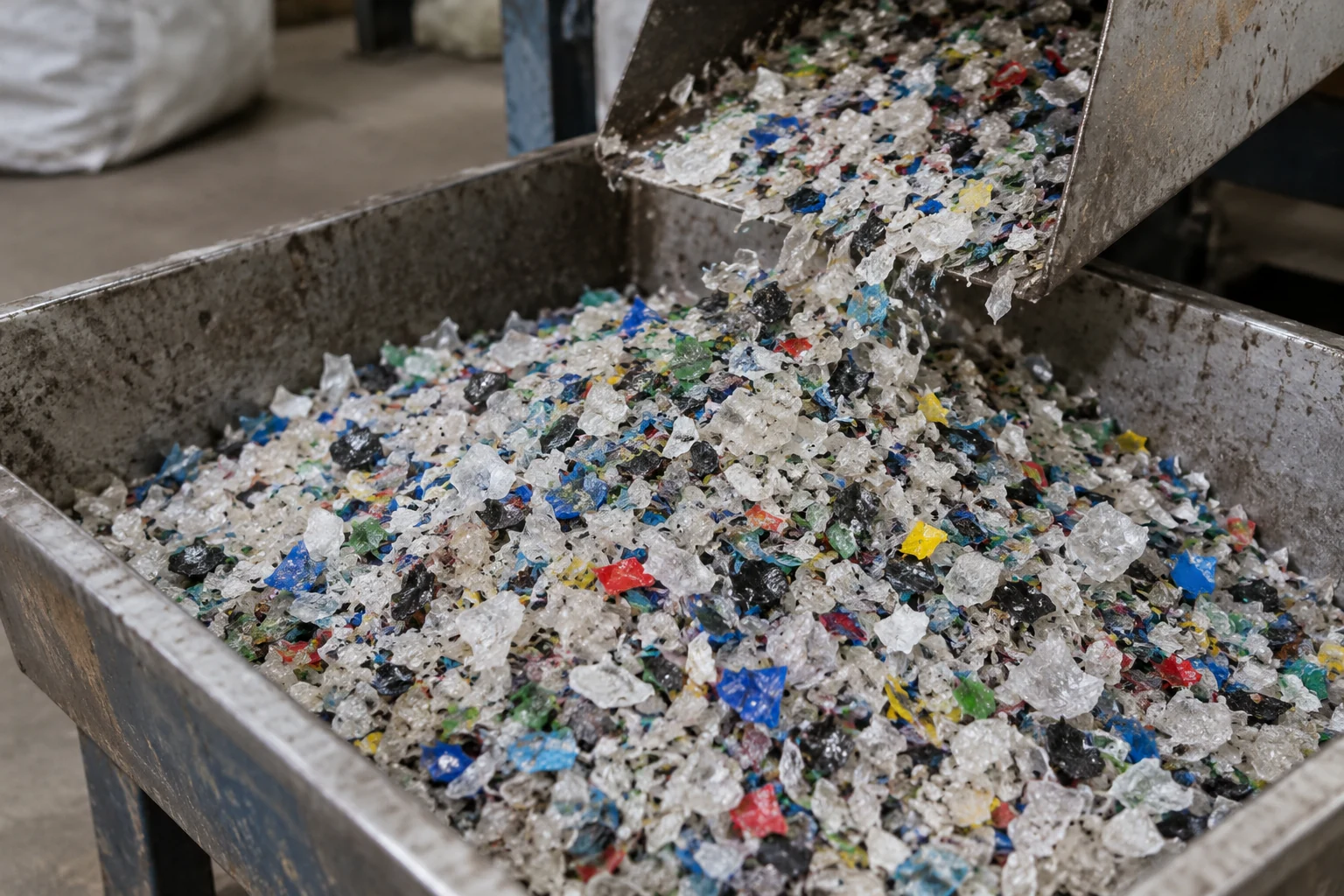
A shredder changes the size of feed material. It does not perform chemical conversion, upgrading or polymerisation. Likewise, a granule packing machine weighs and packs an already defined solid product downstream; it does not create pellets from pyrolysis oil.
Build a material-stream record
| Stream or boundary | Information to request | Do not assume |
|---|---|---|
| Incoming packaging waste | Composition, condition and sampling basis | All received waste enters the reactor |
| Prepared reactor feed | Accepted mass and specification | Size reduction establishes chemical suitability |
| Liquid intermediate | Quantity, analysis and receiving specification | Every liquid fraction is saleable cracker feed |
| Non-condensable gas | Quantity, composition and actual use/treatment | Reuse as fuel removes combustion releases |
| Solid residue | Characterization and documented destination | It is automatically a marketable material |
| Later polymer output | Additional processes and accounting boundary | Pellets leave the pyrolysis step directly |
Choose a common observation period and mass basis. Note stored inventory and streams that are not measured directly. If the balance does not close, retain the discrepancy and investigate it rather than rescaling all outputs into a perfect chart.
Read environmental claims at their stated boundary
The Plastic Energy report distinguishes waste-management and product-production perspectives and identifies a European scope. Its results cannot be transferred to every installation or treated as a local emissions test. Record the reference treatment route, energy assumptions and downstream processes before comparing studies.
Use the emissions-evidence guide when the question concerns monitored releases. A life-cycle result and a stack measurement answer different questions.
Methods and scope
This source-based explainer uses a documented supplier system as an example and a published review overview for process context. It offers no operating recipe, yield guarantee or environmental verdict. The stream worksheet is an editorial aid. Continue in packaging waste recycling. Updated October 2026.